
| Business, Artificial Intelligence, Technology
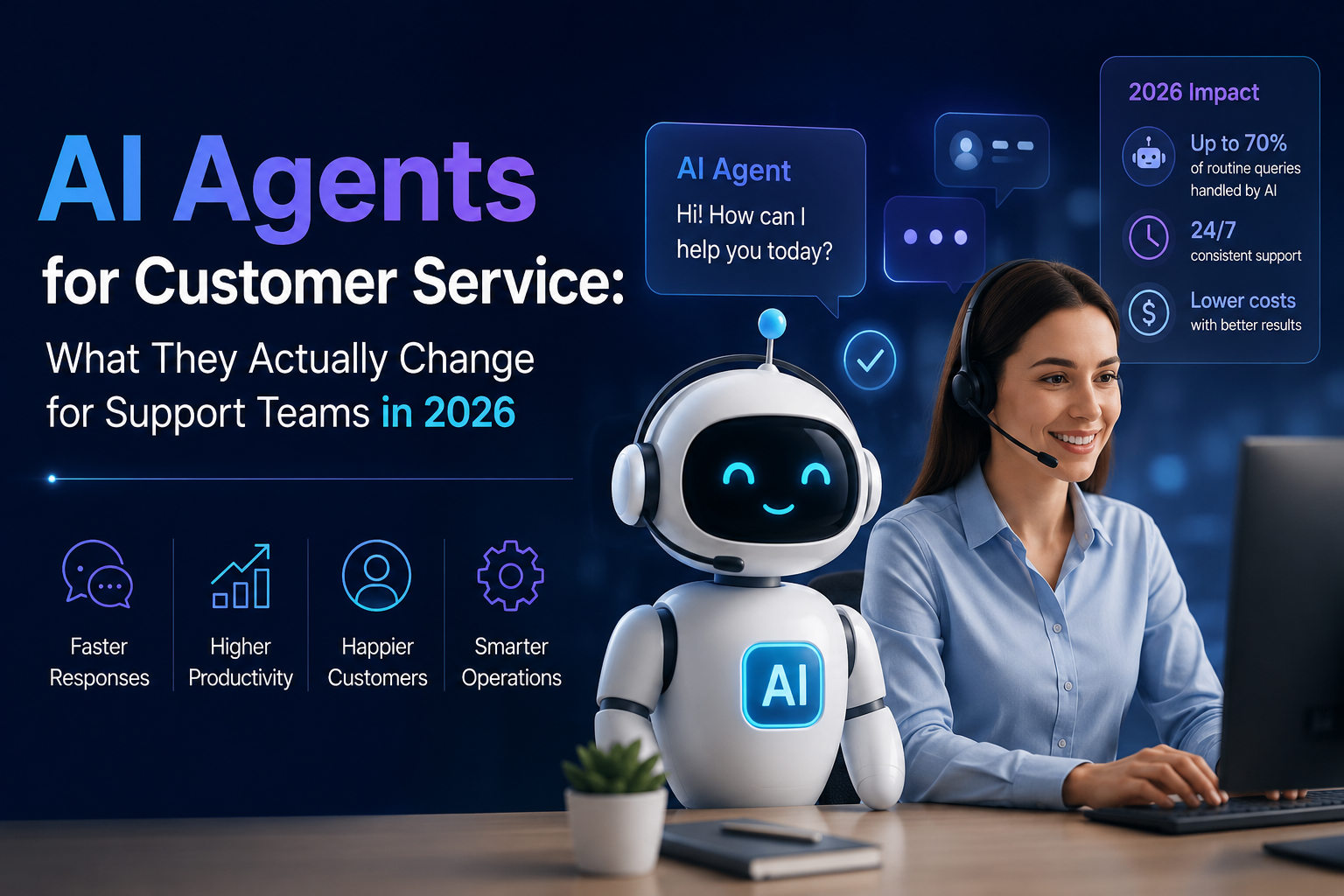
Support Teams Have Reached a Tipping Point
If you run a support team, you've probably felt the ground shift under you in the last year. It isn't just another chatbot update. Something closer to a real shift in how service work gets done is underway, and most teams are still figuring out where they stand.
The numbers back up the feeling. Adoption of AI agents in customer service organizations nearly doubled year over year, and a large majority of service leaders now say they're under pressure from the top of the org chart to get something deployed. That pressure is producing a lot of activity, including pilots, proofs of concept, and half-finished integrations, but not always a lot of clarity about what these tools are actually good at.
This article is meant to cut through some of that noise. Not a hype piece, not a doom piece — just a grounded look at what AI agents for customer service can realistically do today, where they still fall short, and how a support team might think about bringing one in without making a mess of things.
What an AI Agent Actually Is (and Isn't)
It helps to separate "AI agent" from "chatbot," because the two get used interchangeably and that's causing a lot of confusion. A traditional chatbot follows a decision tree. You type something, it matches keywords or intents, and it serves up a scripted response or routes you along a predefined path. It's useful, but it's rigid and breaks down the moment a question wanders off the script.
An AI agent works differently. It reasons over your actual knowledge base, including help docs, policies, past tickets, and product data, rather than a fixed script. It can hold context across a conversation and even across channels, so a customer who starts on chat and follows up by email isn't starting from zero. And, critically, it can take action: look up an order, issue a refund within policy, update an account, or escalate a case with full context attached, rather than just answering questions.
That last piece is the real differentiator. A chatbot tells you what to do. An agent does it. That distinction is why the category has moved from a nice-to-have widget on a website to something enterprise support organizations are building real workflows around.
Where the Value Actually Shows Up
Cost is the most obvious place teams look first, and the gap is real. Handling a routine ticket with a human agent typically runs several dollars once you account for salary, tools, and overhead. Handling that same ticket with a well-built AI agent often costs a fraction of that. Multiply that across thousands of monthly interactions and the math becomes hard to ignore, which is a big reason budget owners keep pushing for faster rollouts.
Speed is the second big lever. Customers today are more patient with a bot than they used to be, as long as it actually solves the problem fast. A good agent doesn't make someone wait in a queue for a password reset or an order status check. It just handles it instantly, at two in the morning if that's when the question comes in.
The third piece, and the one that gets undersold, is what happens to the humans still on the team. When routine, repetitive volume gets absorbed by an agent, the people left in the queue aren't burning their day on password resets. They're handling the cases that actually need judgment, patience, or a bit of empathy, such as the billing dispute that's really about a bad month or the customer who's genuinely upset. That's better work, and it tends to show up in agent retention numbers too.
Where AI Agents Still Fall Short
None of this means AI agents are a plug-and-play replacement for a support team, and it's worth being honest about where they still struggle.
First, there's a real gap between "handling" a conversation and "resolving" it. A lot of the headline adoption numbers you'll see conflate the two. An agent can route, triage, and hold a conversation without ever actually closing out the customer's problem, and teams that don't track resolution separately from volume can end up thinking they're doing better than they are.
Second, trust is still fragile in certain categories. Customers tend to be fine with a bot checking an order status, but noticeably less comfortable letting one make changes to their money or their account without a clear path to a human. Deployments that hide the fact that AI is involved or make it hard to reach a person tend to quickly lose customer goodwill, even if the automation itself works well.
Third, quality depends almost entirely on how well the agent is set up, not on which vendor logo is on the tool. Teams that get real value have almost always spent more time getting their knowledge base accurate, up to date, and well-structured than they have spent choosing a platform. Garbage in, garbage out applies just as much here as it ever did with any other system.
A Practical Way to Roll One Out
Start narrow. Pick two or three ticket types that are high in volume and low in ambiguity, such as order status, account lookups, and simple returns, and let the agent own those completely before expanding. Trying to hand over the entire queue on day one is how pilots turn into cautionary tales.
Keep the knowledge base the agent draws from clean and current. This is unglamorous work, but it matters more than any model choice. An agent is only as accurate as the material it's pulling from, so treat documentation upkeep as part of the rollout, not an afterthought.
Build the escalation path before you need it, not after. Decide up front which situations are handed to a human, how much context travels with that handoff, and how a customer can ask for a person without having to fight the bot to get there. The deployments that keep customer trust are the ones that make that path obvious and easy.
Finally, measure resolution, not just volume. Track how many conversations the agent actually closes without a human touching them again, not just how many it responded to. That single number will tell you more about whether the rollout is working than almost anything else you could look at.
Where This Is Heading
The direction of travel is fairly clear. More of the routine volume is moving to agents, human teams are shrinking in headcount devoted to repetitive work while growing in the complexity of what they handle, and voice is starting to catch up to chat as a channel agents can competently manage. None of that means support teams disappear. Leadership at most organizations is still explicit about keeping human agents in the loop, just with a different mix of what those agents spend their time on.
For a support leader deciding what to do next, the honest advice is to stop treating this as a binary choice between "add a chatbot" and "do nothing."
AI agents for customer service can support this shift by reasoning across a knowledge base, taking appropriate actions within connected tools, and handing cases off to a human when additional judgment or assistance is needed.
Start with the boring, high-volume, low-risk work. Get the knowledge base right. Build a clean handoff to your human team. And measure the thing that actually matters: problems solved, not conversations touched. That's a rollout that holds up, whether it's your first month running an AI agent or your fiftieth.
0 Comments
Comments are moderated to keep the discussion useful and respectful. Spam, automated submissions, and low-value promotional comments are removed.
Leave a Comment