
| Yuliya Melnik | Artificial Intelligence, Technology, Web Development
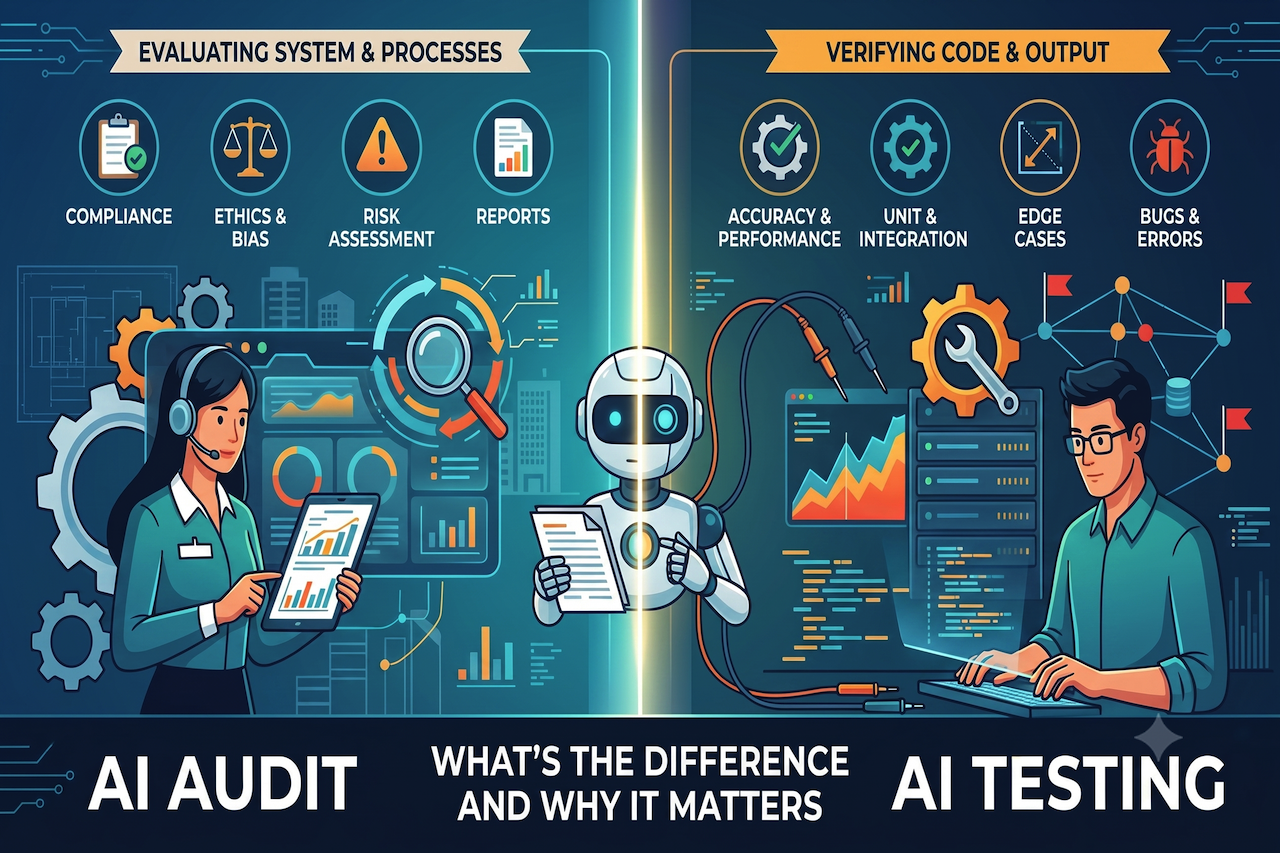
An AI system can still get through technical tests, but that doesn’t mean it’s safe for real business. That’s why more and more companies evaluate factors beyond just model accuracy. A system can hit its performance targets yet quietly produce unfair outcomes or become less reliable as production data and real-world conditions change over time.
AI testing and AI auditing both help uncover issues, but they aren’t the same thing. Testing is mostly about whether a model (or even a small feature) works the way it was supposed to. An audit, on the other hand, evaluates the wider AI system. That includes its data pipeline, security controls, documentation, oversight, and how it’s actually used once it’s in production.
Once product teams understand that distinction, they can pick the right kind of check at each step of the AI lifecycle, rather than mixing up assessment moments that really need different goals.
What is AI testing?
AI testing tests the behavior of a model or an AI application within certain conditions. The primary goal is to detect technical problems, poor performance, and any unexpected output before it impacts users.
The testing of AI systems is more complex than that of traditional software because the behavior of such a system depends on the training data, model settings, prompts, and user inputs. Tests should include both application functionality and model performance.
Typical testing might include:
- Accuracy of the model and error rates
- Consistency of the responses
- Performance under different loads
- Software integration
- Tolerance to bad input
- Output change after updates
For instance, an eCommerce organization can test whether its recommendation system suggests relevant recommendations depending on customer profiles. Response time and system stability during peak traffic can be tested as well.
Testing is an answer to the practical question: does the AI system work properly?
What is an AI audit?
An AI audit takes a broader look at the whole system, not just one part, such as the tech and the organization in general. It evaluates the model as well, but it also seems to include how the business gathers data, how it handles risks, how it documents its decisions, and what it does to monitor the product after release.
The evaluation may include:
- Data quality and source
- Potential for bias and fairness
- Security and privacy measures
- Explanation capabilities
- Human involvement
- Decision accountability
- Production monitoring
- Regulations that apply
Imagine a lending business which uses AI to assist in making credit decisions. The testing can prove that the model receives applications and delivers its outputs. However, an audit also focuses on whether the data covers all important applicant segments and whether employees can interpret the decision.
The audit asks a more comprehensive question: "Can we trust this AI?"
Key differences between AI audits and AI testing
However, even though they share a few commonalities, they still vary in some respects, in a sort of practical way:
- Purpose: The goal behind testing is proof of technical behavior, while auditing is more about risk assessment.
- Scope: Testing tends to focus on model performance, but auditing extends further to include the assessment of data, infrastructure, governance, and documentation.
- Participants: Testing is usually driven by technical teams, while auditing often involves legal, security, and business stakeholders.
- Timing: Testing typically occurs during development, while auditing often takes place before deployment or after significant changes.
- Outcome: Testing is intended to identify bugs and operational issues, whereas auditing focuses on evaluating and managing risk.
So the model might pass technical tests but still fail an audit because of biases and weak controls. Likewise, having strong governance does not automatically mean no technical flaws will show up, even if everything looks good at first.
Why AI testing alone is not enough
Testing typically follows predefined scenarios. Teams establish expected outcomes, prepare input data, execute test cases, and evaluate the results against predetermined requirements. This structured process helps verify that the system behaves as expected under known conditions.
Some dangers related to AI can exist beyond these scenarios. Inadequate training data and a lack of accountability around model updates can slip past developers. Slow performance deterioration after deployment can go unnoticed if the company has no production monitoring.
Testing can fail to identify:
- Dangers that affect only a few end users
- Poor documentation regarding data gathering
- Privacy threats from third parties
- Lack of production monitoring
- Indecisions that cannot be questioned by users
An audit makes a connection between these dangers and the organization running the technology.
Why an audit cannot replace testing
An audit gives broader oversight, but it doesn't really remove the need for deep technical checks. Every model update or new integration can still bring in defects, even if the organization is doing a lot with governance practices and other controls.
Testing also helps as proof for an audit. Performance benchmarks, regression findings, and security assessments all help show if the documented controls are actually working in practice. If that evidence is missing, auditors might only be able to confirm that policies exist, but they cannot really say whether the product follows them consistently or not, every time.
When is AI testing needed?
Testing must be done at the time of development and must go on as long as the organization continues using the AI. Testing becomes crucial when:
- The team launches a new model
- Developers modify prompts/parameters
- The product connects to a new data source
- An external AI company updates its service
- Users complain about inconsistent output
- The organization deploys the AI to a new use case
Team members have to perform regression testing after every major update. An improvement in one aspect of the system can lead to degradation in another.
Monitoring in production must come in addition to testing. User input can be very different from that of the test dataset, which is why monitoring is important.
When is an AI audit needed?
The audit becomes necessary where AI impacts significant business or user outcomes. The need arises where the system deals with sensitive data or makes decisions in such regulated sectors like healthcare, finance, employment, etc.
Reasons for conducting an audit could be:
- Prior to launching a high-impact AI system
- After modifying the model or data set
- Prior to entering a new jurisdiction
- Prior to engaging an enterprise-level customer
- After any incident relating to AI
- On periodic review of risks
An audit shouldn't be limited to being merely an approval exercise. The models or data sets can keep changing while business processes can also change.
How AI testing and audits work together
Companies can blend both of these processes across the entire product lifecycle, more or less. In the discovery phase, the team talks about the intended use, and also figures out what counts as unacceptable outcomes. Then developers convert those expectations into requirements and test cases, and pin them down.
In development, engineers test the model, the integrations, and how the application actually behaves. They also write down what they saw plus the known constraints and limitations.
Right before deployment, an audit looks at whether the evidence that exists really backs up the release decision. Reviewers check the technical outcomes together with the data practices, the security controls, and who is on the hook for operational responsibilities.
After the launch, monitoring keeps generating new evidence for the next round of tests and audits. The team can then match what really happened against its initial expectations, and adjust the safeguards and controls when circumstances shift.
Common mistakes to avoid
One common mistake is measuring only average accuracy. A strong overall score can sometimes mask poor outcomes for one specific user group or an uncommon situation, and then nobody notices until it's too late. Teams should assess each relevant scenario separately, as each presents different risks and considerations.
Another mistake is reviewing only the model, as if that’s the only thing that matters. AI products also depend on databases, APIs, interfaces, and human decisions, so if one piece is off, the final result can wobble. A weakness in any component can affect everything downstream.
Companies also add unnecessary risk when nobody owns production monitoring. When clear thresholds are set and responsibilities are assigned, teams can respond when performance begins to decline, not after.
Finally, an audit does not mean an AI system will never fail. It points out current weaknesses and checks the existing controls, but it does not remove the future risk. Continuous testing and ongoing monitoring remain necessary even after the assessment.
Final thoughts
AI testing and AI auditing are closely related, but they serve different purposes. Testing focuses on verifying that a model or application performs as expected under predefined conditions by running test scenarios, observing its behavior, and evaluating the results against established requirements. Auditing takes a broader view, assessing whether the overall AI system operates within acceptable technical, organizational, legal, and governance standards.
Most companies still need testing, because you want to catch defects early and confirm performance details, not just guess. They also need auditing, because it helps explain the wider risk picture, and it improves oversight in a more structured sense. When you combine both, you get a steadier base for rolling out AI and then managing it, even after the launch, when things usually get more complicated.
Author

Yuliya Melnik
0 Comments
Comments are moderated to keep the discussion useful and respectful. Spam, automated submissions, and low-value promotional comments are removed.
Leave a Comment