
| Raksha Sharma | Cloud Services, Networks, Cybersecurity
Every time a viewer hits play on a live match, a new episode, or a game update, a content delivery network fires off a trail of data behind the scenes — cache hits, routing decisions, latency readings, authentication events. For much of its history, this trail has been regarded as exhaust – good for debugging purposes but never looked at in its entirety. This is not the case anymore. With the advent of streaming services, gaming, and cloud-native applications causing an unprecedented spike in global data volumes, the software used for analyzing logs from CDNs in real time has emerged as one of the fastest-growing segments of enterprise IT.
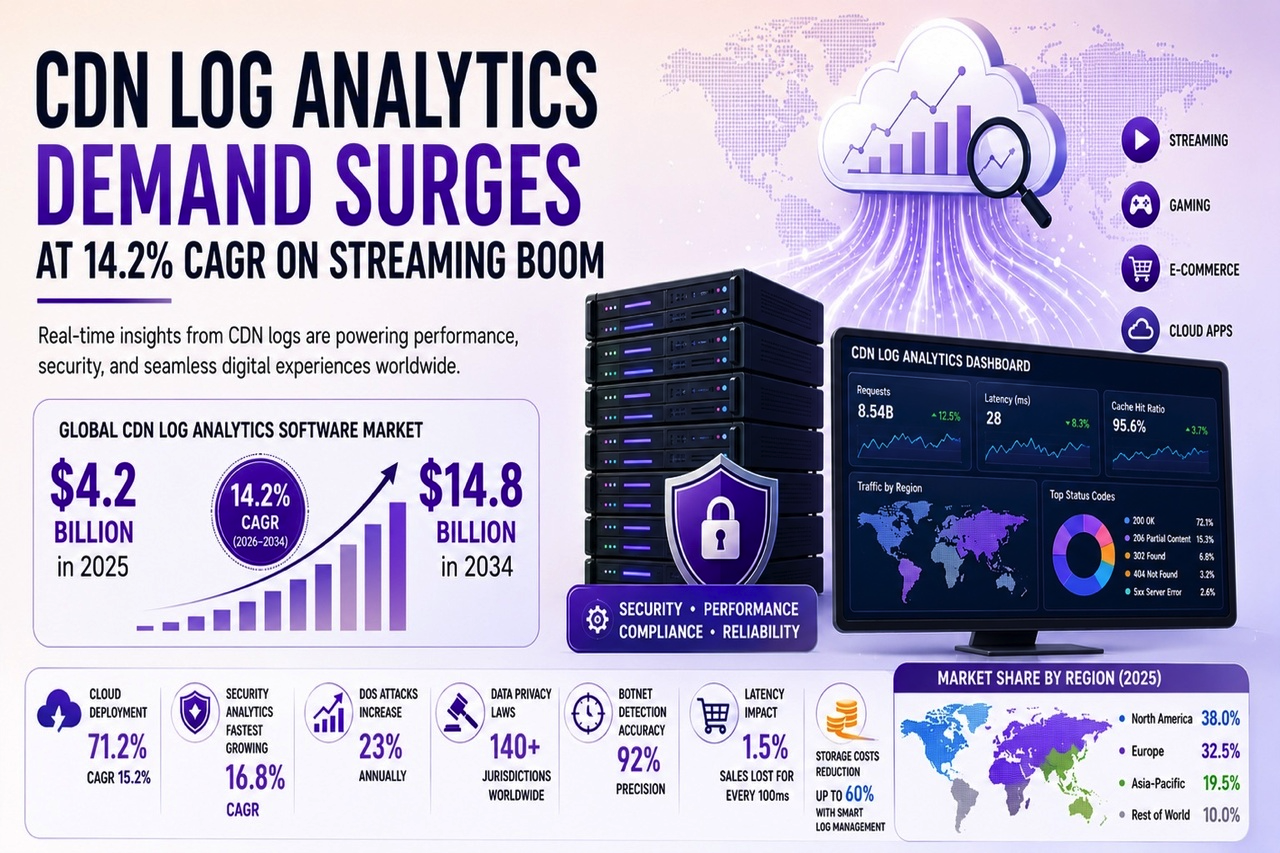
As per the latest research report published by Marketintelo, the global expenditure on CDN log analytics amounted to $4.2 billion in 2025 and will further be valued at $14.8 billion in 2034, registering a compound annual growth rate of 14.8%. Amongst these statistics, it is the software sector, which constitutes the majority of this figure accounting for 62.5% of the total market revenue, and is expected to grow at a CAGR of 14.2%. That's a segment more than tripling in size over the coming decade, driven almost entirely by the same forces reshaping how content moves across the internet.
The Streaming Backdrop
The scale of the underlying traffic explains why. Streaming video has become the dominant form of global internet activity, and content delivery infrastructure has scaled accordingly to keep pace with rising resolution standards and viewer expectations. That expansion of delivery infrastructure produces a proportional volume of log data that someone, somewhere, has to make sense of which is precisely the gap CDN log analytics platforms are built to fill. The research estimates that large enterprises now process 500+ terabytes of CDN log data monthly, with organizations facing storage costs ranging from $50,000 to $500,000 a month depending on retention policy and compression efficiency.
Recent Developments
The report points to several concrete shifts underway:
- Multi-cloud operations have become the norm: Approximately 75% of enterprises had adopted hybrid or multi-cloud strategies by 2026, with adoption expected to continue increasing as organizations distribute workloads across multiple providers. This shift significantly increases the volume and diversity of log data that analytics platforms must collect and correlate.
- Attack volumes continue to increase: Distributed denial-of-service (DDoS) attacks have continued to rise in frequency, with application-layer attacks becoming more common. Unlike traditional volumetric attacks, these threats often require detailed log analysis and behavioral monitoring for effective detection.
- Regulatory obligations continue to expand: Data privacy and cybersecurity regulations have grown across many jurisdictions, increasing the need for immutable, timestamped audit logs to support compliance, security investigations, and governance requirements.
- Machine learning has become a core analytics capability: Modern log analytics platforms increasingly use machine learning to identify traffic anomalies, detect malicious activity, and prioritize security events, helping organizations reduce response times and improve threat detection accuracy.
Growth Factors
Several structural forces sit underneath the topline figures:
- Growing demand from streaming and media: Media and entertainment organizations continue to expand their use of CDN log analytics to monitor streaming performance, identify buffering issues, verify content delivery quality, and detect unauthorized content distribution.
- Cloud-native infrastructure adoption: As organizations increasingly adopt cloud, hybrid, and multi-cloud environments, CDN log analytics platforms are being used to collect, process, and analyze data across distributed infrastructure while maintaining centralized visibility.
- Increasing focus on security analytics: Rising cyber threats are driving greater demand for log analytics that can identify anomalies, detect malicious activity, and support faster incident response through real-time monitoring and threat detection.
- Expanding regulatory compliance requirements: Organizations continue to invest in log analytics to support compliance with data privacy and cybersecurity regulations by maintaining audit trails, monitoring access, and generating reports for regulatory requirements.
- Performance monitoring protects business outcomes: Website and application performance directly affect user experience and business results. Real-time CDN log analytics help organizations identify latency issues, troubleshoot delivery problems, and optimize application performance before they impact customers.
Outlook by Segment and Region
Industry Segment
| Industry Segment | 2025 Share % | CAGR (2026–2034) |
|---|---|---|
| Software | 62.5% | 14.2% |
| Services | 37.5% | 15.8% |
| Cloud Deployment | 71.2% | 15.2% |
| Deployment On-Premises | 28.8% | 13.8% |
| Security Analytics (Application) | 24.2% | 16.8% |
| Network Performance Monitoring | 28.5% | 13.5% |
From the regional perspective, North America is leading in terms of market share with 38.0% of revenue, which is primarily attributed to the presence of cloud infrastructure vendors and the compliance enforcement in finance and healthcare sectors. Coming in second position is Europe, which contributes 32.5% to the market share. Europe is growing at a marginally higher rate of 15.2% CAGR, driven by GDPR related investments. The Asia-Pacific market holds only 19.5% market share, but the highest growth rate can be seen in the region of 17.8% CAGR owing to digitalization in Southeast Asia, increasing IT services in India, and e-commerce.
Key Insights
Pulling the data together, a few conclusions stand out:
- Managed services continue to gain momentum: As log volumes increase and environments become more complex, many organizations are supplementing software deployments with managed and professional services to support implementation, monitoring, optimization, and ongoing operations.
- Security remains a primary driver: Growing cyber threats and increasingly sophisticated attack techniques are driving greater investment in security analytics, enabling organizations to detect anomalies, investigate incidents, and respond more quickly to emerging risks.
- Cloud-native adoption continues to expand: The growing use of cloud-native infrastructure and increasing adoption among small and medium-sized businesses are making CDN log analytics more accessible through scalable, subscription-based platforms.
- Cost optimization is becoming increasingly important: Organizations are adopting strategies such as log filtering, data lifecycle management, and tiered storage to manage rapidly growing log volumes while balancing performance, compliance, and infrastructure costs.
None of these point toward a slowdown. With streaming consumption still climbing, security threats compounding rather than plateauing, and regulatory frameworks multiplying worldwide, the volume of data flowing through content delivery infrastructure and the pressure to make sense of it in real time shows no sign of easing.
Conclusion
CDN log analytics has become an important part of modern IT operations as organizations manage growing volumes of traffic across cloud platforms, streaming services, and distributed applications. Beyond troubleshooting, these platforms support security monitoring, performance optimization, operational visibility, and regulatory compliance. As digital infrastructure continues to expand and real-time data becomes increasingly important, CDN log analytics is expected to remain a key technology for helping organizations monitor, analyze, and optimize content delivery at scale.
Author

Raksha Sharma
0 Comments
Comments are moderated to keep the discussion useful and respectful. Spam, automated submissions, and low-value promotional comments are removed.
Leave a Comment