
| Kanika Vatsyayan | Cybersecurity, Web Hosting, Web Development

Digital infrastructure is always under attack by cyber attackers. Every few seconds, web apps are under attack, targeting proprietary databases, payment gateways, and personal identifiers.
Industry research shows the global average cost of a data breach is now over $4.88 million per incident. That sum comprises direct recovery expenses, regulatory fines, and permanent loss of revenue. Security breaches are not only a matter of server logs, but they may also undermine your brand reputation and wipe your search engine visibility overnight.
Website security testing is the systematic analysis of an online application to find technical vulnerabilities, configuration errors, and software bugs before a bad actor may exploit them. A schedule of planned assessments helps minimize inadvertent exposures and keep digital processes running without interruption.
Overview of Web Application Security Testing Types
An effective protection plan combines several review techniques across the software development life cycle.
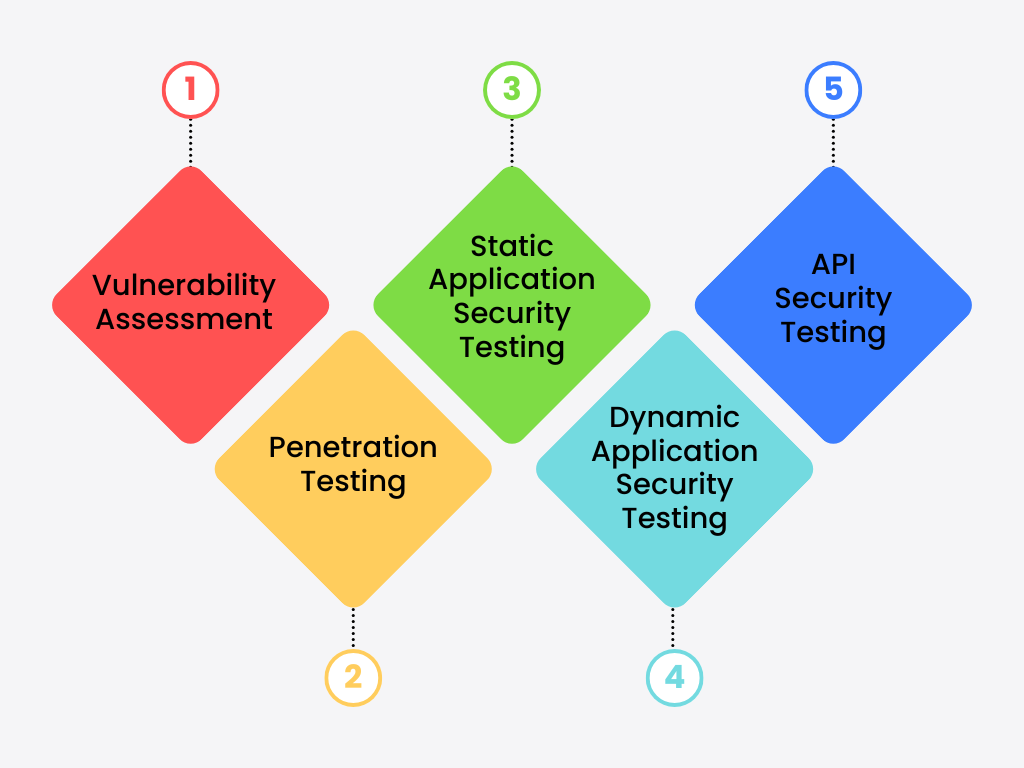
Vulnerability Assessment
Vulnerability assessments involve the automated scanning of the codebase, web servers, and network. These tools give detailed information on known weaknesses, obsolete dependencies, and configuration errors. This is the first step, providing a general overview of the cleanliness of your architecture.
Penetration Testing
In the world of penetration testing, an automated scan is not the end-all, be-all. Manual simulations are performed by security experts who use custom-made exploits and multi-step escalation techniques for real-world attacks. We can find meaningful insights into exploitable vulnerabilities that automatic scanners cannot.
Static Application Security Testing (SAST)
SAST analyzes the source code of an application as it is not running. Engineering teams use this code analysis to uncover coding errors, hardcoded credentials, and SQL injection vulnerabilities before publishing code to staging environments.
Dynamic Application Security Testing (DAST)
In DAST, tests are performed from the outside-in, with an actual working application. It tests the integrity of the input parameters against live HTTP endpoints, forms, and authentication procedures. DAST is able to find runtime issues without access to the underlying source code, including issues like failed access control and cross-site scripting (XSS).
API Security Testing
APIs are used by modern web applications to exchange data. Test an API for security and check endpoints for vulnerabilities such as broken object-level permission, bulk assignment, and data exposure. This helps keep backend data pipelines secure.
Evaluating an enterprise's overall risk profile often starts with studying benchmark reports from companies specializing in security testing to understand common evaluation criteria across various tech stacks.
Technical and Operational Advantages of Security Audits
Systematic website security testing gives quantitative protection for a variety of business tasks.
- Early Vulnerability Identification: Attackers can access through software updates, third-party plugins, and legacy integrations. Rather than emergency patches after an incident, systematic testing will lower patching costs, as vulnerabilities will be discovered before external scanners.
- Data Breach Prevention: Millions of client records might be compromised by a single unpatched zero-day vulnerability or incorrectly configured file. It provides regular testing and prevents unauthorized access to the database, thus safeguarding important financial data and business logic.
- Customer Data Protection: Keeping personal data accurate, current, and secure is paramount in regulatory compliance standards like GDPR, HIPAA, and PCI-DSS. Thorough security evaluations help protect consumers from identity theft and credit card fraud by ensuring that data is encrypted while it is in transit and at rest.
- Brand Reputation Preservation: A security breach has a greater negative impact on brand authority than a product fault or outage. A robust security position demonstrates reliability and assists in maintaining customers wary of privacy issues.
To sustain the momentum of continuous protection, without slowing down release cycles, engineering teams are including automated security testing into CI/CD pipelines. Automated security checks liberate human testers for complicated, high-impact security situations.
The Invisible Threat: How Security Weaknesses Destroy SEO
User safety is paramount for search engines. Algorithms actively judge online safety flags, as well as site performance and content quality. Skipping web application security testing has a direct impact on organic search.
- Compromised Site Detection: Crawlers find malware payloads, phishing scripts, or illegal redirection on web pages.
- Search Console Warnings: Search engines mark the property as under security Issues and display warning interstitials to users attempting to view blacklisted pages.
- Traffic Loss: Click-through rates immediately decline, resulting in significant ranking losses and substantial loss of organic traffic.
Real-World Attack Scenario: Japanese Keyword Hack & Conditional Cloaking
Think about the Japanese Keyword Hack, a popular exploit. Attackers inject and alter automatically produced database entries by taking advantage of unpatched CMS vulnerabilities or compromised access controls. Configuration files for htaccess.
Conditional cloaking is used by the virus to make the page look normal when a regular user accesses the URL. However, in response to a request for the website from a search engine crawler (such as Googlebot), the server automatically generates spam pages that lead to unauthorized stores and are packed with Japanese content.
Site owners are oblivious until search engines crawl thousands of these spam URLs since typical visitors do not notice any changes. Core landing pages are completely de-indexed as a result of an instantaneous security manual action in Search Console.
Search Console Flags and Warning Interstitials
When search crawlers find hacked scripts, phishing material, or malware payloads on a site, search security teams mark the property in Google Search Console under several security classifications:
- Deceptive Pages / Social Engineering: Phishing scripts designed to steal user credentials.
- Code Injection: Unverified scripts modifying page DOMs to serve malicious ads.
- Malicious Downloads: Drive-by download scripts disguised as legitimate software updates.
When they are reported, search engines show big warning messages to users (“The site ahead contains harmful programs”) and incoming traffic drops to nothing.
Technical Integration and Continuous Security Lifecycle
Security assessments shouldn't be considered as isolated events that happen just before going live. Integrating testing frameworks into current development workflows creates a robust stance.
Integrating Security into CI/CD Pipelines
You may implement automatic static analysis and dependency scanners into your continuous integration and continuous deployment workflows to verify each contribution against security standards. Code with high-severity vulnerabilities is immediately blocked from merging, reducing technical debt and maintaining clean production code.
Remediation and Verification Loops
Finding security weaknesses is just half the fight. Organizations must set specific timeframes and methods for re-testing. When developers address a known problem, the patch is verified by test automation or manual re-tests to see if it works well and does not introduce new functional regressions.
Securing Your Digital Footprint
Protecting web infrastructure has no end. It’s not a one-and-done thing. “Every year online dangers are getting more sophisticated, so you can’t rely on manual checks alone. Regular website security testing protects sensitive user details, keeps critical company processes running, and helps you maintain exposure in search engines.
Structured security evaluations are an investment in protecting brand value, ensuring compliance, and securing long-term search engine growth.
Author

Kanika Vatsyayan
0 Comments
Comments are moderated to keep the discussion useful and respectful. Spam, automated submissions, and low-value promotional comments are removed.
Leave a Comment