
| Ravi Kant | Ecommerce
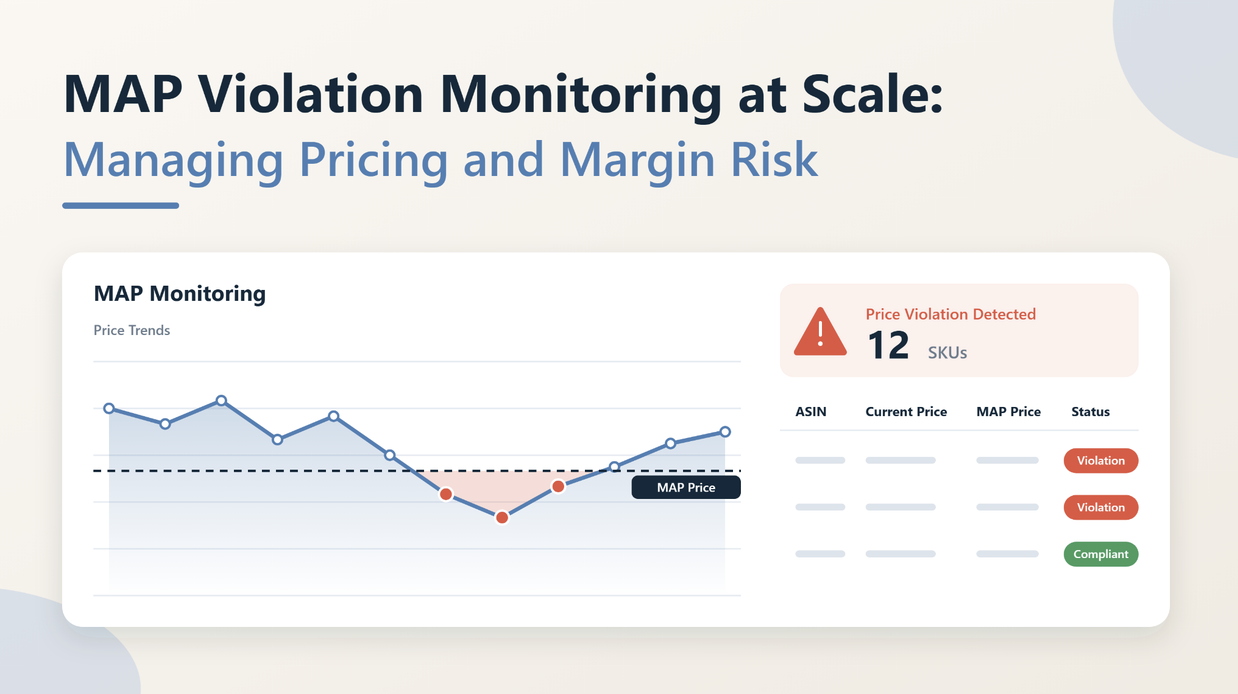
A significant share of online reseller pricing can fall below a brand’s minimum advertised price (MAP) without immediate detection. GrowByData’s analysis of 600K+ reseller-SKU observations found that 33.3% of Google Shopping observations were below MAP.
The issue becomes increasingly complex as catalogs, reseller networks, and sales channels expand. A MAP violation monitoring program has to identify the right product, distinguish sellers correctly, interpret the advertised price according to the policy, and retain enough history to show whether a breach is isolated or recurring. It also has to detect violations within a useful timeframe, because a below-threshold offer that remains visible for hours or days creates a longer window for the pricing discrepancy to affect other sellers and shoppers.
Why MAP Violation Monitoring Becomes More Difficult with Large Catalogs
The setbacks in large-scale monitoring usually come from gaps in how the program identifies products, sellers, channels, and pricing conditions. Increasing scan frequency does not close those gaps when the underlying observations are incomplete or mismatched.
Product Matching Creates the Foundation for MAP Compliance
A price observation has little value if it is attached to the wrong SKU. Title-based matching can confuse color or size variants, multipacks, bundles, and closely related products. Those errors can create false violations while letting actual breaches slip through as unmatched offers.
Reliable MAP violation monitoring therefore needs to map each observed listing back to the correct master product record. GTINs, UPCs, manufacturer part numbers, pack quantities, and variant attributes provide stronger identifiers than product titles alone. The matching logic also needs to account for products that appear under different naming conventions across retailer websites and marketplaces.
This matters because the applicable MAP amount may change with the product configuration. A single-unit product and a six-pack cannot automatically be treated as equivalent observations simply because their titles contain the same model name.
Advertised Price Needs to be Interpreted Against the MAP Policy
The displayed list price may not be the price a shopper can actually get. Coupons, promotional codes, cart-level discounts, bundles, and other offer mechanics can reduce the effective advertised price without changing the headline price shown on the product page.
The monitoring process therefore needs to evaluate the offer according to how the brand’s MAP policy defines an advertised price. A numerical comparison between the displayed price and MAP is not enough when the policy covers additional forms of discounting. This distinction matters when teams review large numbers of alerts and need to separate a genuine MAP violation from a pricing condition the policy permits.
Seller Identity Affects How a Violation Should be Interpreted
Seller attribution becomes harder when the same reseller operates across multiple channels or presents different storefront names. Treating each seller name as a separate entity can fragment the violation history and make repeat behavior difficult to identify.
GrowByData’s analysis illustrates the scale of that problem. Across the brands included in its cross-channel comparison, about 98% of violating Google Shopping reseller names were not identified under the same name through marketplace monitoring. The report also notes that reseller matching was based on displayed reseller names, so naming differences can affect whether the same underlying seller is recognized across channels.
For MAP enforcement, seller identity therefore needs to sit alongside the price observation. A brand needs to know not only which offer breached the policy, but whether the seller has appeared in previous cases and whether the same reseller is active elsewhere under another storefront identity.
Alert Volume Can Obscure the Violations that Need Attention
Large catalogs naturally produce a high volume of price observations. Flagging every deviation without considering context can push repeat offenders, high-volume products, and persistent breaches into the same queue as isolated or low-impact cases.
The goal is not to suppress alerts. It is to preserve enough context around each alert to distinguish different behavior patterns. A seller that drops below MAP once and returns to compliance is not creating the same monitoring problem as a seller that repeatedly advertises the same products below the policy threshold.
From Channel Coverage to Seller Coverage in MAP Violation Monitoring
Monitoring coverage has to reflect where a brand’s products are actually being advertised, not simply which marketplaces the team already manages. An automated tool can scan Amazon or an authorized reseller list several times a day and still miss sellers appearing elsewhere.
GrowByData recorded the highest MAP violation rate in its Google Shopping observations, at 33.3%, compared with 20.9% on Amazon and 10.0% on Walmart. The report also notes that channel coverage varied across the six brands, so those rates are specific to the dataset rather than universal benchmarks for each marketplace.
The more important distinction is what each source reveals. Marketplace monitoring provides visibility into sellers operating within that marketplace environment. Reseller-site monitoring can capture offers published directly on retailer domains. Shopping environments can expose a broader set of seller names because offers from independent retailers and marketplace storefronts can appear together.
This wider view also helps explain why a channel list built only from known authorized retailers can become outdated. New sellers can enter a category, existing sellers can open additional storefronts, and marketplace-linked retailers can surface through shopping placements even when the brand has never included them in its monitoring roster. Channel coverage should therefore be treated as part of the monitoring data itself.
Patterns in MAP Violation Monitoring Reveal More Than Individual Breaches
A single price observation establishes that an offer was below the applicable MAP at a specific point in time. It does not explain whether that event represents an isolated pricing decision, repeated reseller behavior, or a broader pattern affecting the channel.
This distinction becomes visible when monitoring retains historical observations instead of overwriting them after a seller corrects the price.
A rise in first-time violating sellers can point to an expanding seller population that deserves closer examination. Seasonal movement can indicate periods when existing scan schedules provide less coverage than the pricing environment demands.
Why Detection Latency Matters Once a MAP Breach is Found
Detection latency matters once coverage and data quality are in place. A monitoring program can identify the right seller and the right SKU, but the timing of that detection still affects how long the below-MAP price remains publicly visible.
A violation’s price impact doesn’t automatically extend to every seller, and a low offer doesn’t prove that another reseller will match it. The practical concern is the exposure window. The longer a below-threshold price remains live, the longer shoppers and competing sellers will see it before the brand verifies the breach and begins the appropriate response.
A MAP Violation Monitoring Workflow for Large Catalogs
A scalable workflow needs to connect product identity, pricing rules, seller history, evidence, and case handling without sending every observation through the same review path. This six-step structure keeps those functions connected while letting monitoring effort reflect differences in exposure.
1. Tier the Catalog by Exposure
Not every SKU creates the same MAP compliance concern. High-revenue products, products carried by many sellers, and products that experience frequent pricing changes generally create a larger monitoring surface than long-tail items with limited reseller activity.
Organize SKUs into practical monitoring tiers using factors such as revenue contribution, seller count, historical violation frequency, and channel exposure. High-exposure products can support more frequent checks, while lower-exposure products can remain on a less frequent monitoring schedule.
The tiers should also change over time. Product launches, seasonality, reseller expansion, and recurring violation patterns can change a SKU's relative exposure, making a static monitoring schedule increasingly disconnected from the actual catalog.
2. Normalize Product Identity
Map every monitored offer to the brand’s master product record using identifiers such as GTIN, UPC, manufacturer part number, pack quantity, and variant attributes.
Where multipacks or bundles are involved, calculate the product configuration correctly before comparing the offer with MAP. This step reduces false positives and gives subsequent seller and pricing analysis a reliable product reference.
3. Calculate the Applicable Advertised Price
Begin with the displayed price, then account for the discount mechanisms covered by the MAP policy. Depending on the policy, this can include coupons, promotional codes, cart-level discounts, or bundled value.
The calculation needs to follow the policy definition rather than an assumed rule. A monitoring program should identify when the effective advertised price falls below MAP while preserving the offer context that explains how the lower price was reached.
4. Separate Isolated Breaches from Recurring Patterns
Once a potential violation is identified, add historical context before routing the case. Relevant factors include the depth of the price deviation, seller status, SKU exposure, duration, and previous violations associated with the seller or reseller-brand combination.
This approach keeps a one-time observation from being treated as equivalent to a recurring pricing pattern. It also helps review teams understand whether a seller corrected the price after an earlier incident or continued to advertise below the policy threshold.
5. Capture Evidence at Detection
A violation record should preserve the information needed to establish what the brand observed and when. That typically includes the SKU, seller identity, advertised price, applicable MAP, source URL or channel location, and timestamp.
Historical evidence is particularly useful when a seller corrects the price before the case is reviewed. Without a preserved record, the brand may know that a violation was detected but have less information available to establish what was actually displayed when the case entered the system.
6. Route Cases by Seller Relationship
Seller status affects what the brand can reasonably investigate and how the case fits within its MAP enforcement process.
Authorized resellers can be reviewed against the applicable MAP policy and the terms governing their relationship with the brand. Repeat violations can then be evaluated in the context of documented history rather than as isolated events.
Unauthorized sellers require a different type of investigation. Monitoring can establish where the seller advertised the product, which SKU was involved, the observed price, and the frequency of violations. It cannot, by itself, establish where that seller obtained the inventory.
Marketplace-related cases should also remain distinct from marketplace policy complaints. A MAP violation is primarily a pricing-policy issue between the brand and the seller, while marketplace enforcement mechanisms may address separate violations governed by the channel’s own terms.
The monitoring workflow should therefore preserve those distinctions instead of routing every below-MAP observation through a single enforcement path.
Turning Price Integrity into Retained Margin
The practical value of MAP violation monitoring does not come from producing the highest possible number of alerts. It comes from improving the quality and completeness of the pricing picture available to the brand.
At scale, that picture needs to connect five pieces of information: the correct SKU, the seller advertising it, the channel where the offer appears, the advertised price relative to the applicable MAP, and the violation history. Without those connections, a brand can detect individual breaches while still struggling to understand whether they are isolated incidents, recurring seller behavior, or evidence of broader gaps in channel visibility.
A mature monitoring program therefore gives the brand more than a list of prices below the minimum advertised price. It provides a defensible record of where violations occur, how frequently they recur, how seller coverage changes, and how quickly the organization can move from detection to an informed enforcement decision.
Author

Ravi Kant
0 Comments
Comments are moderated to keep the discussion useful and respectful. Spam, automated submissions, and low-value promotional comments are removed.
Leave a Comment