
| Ashish Kolte | Cloud Services, Data & Databases, Business
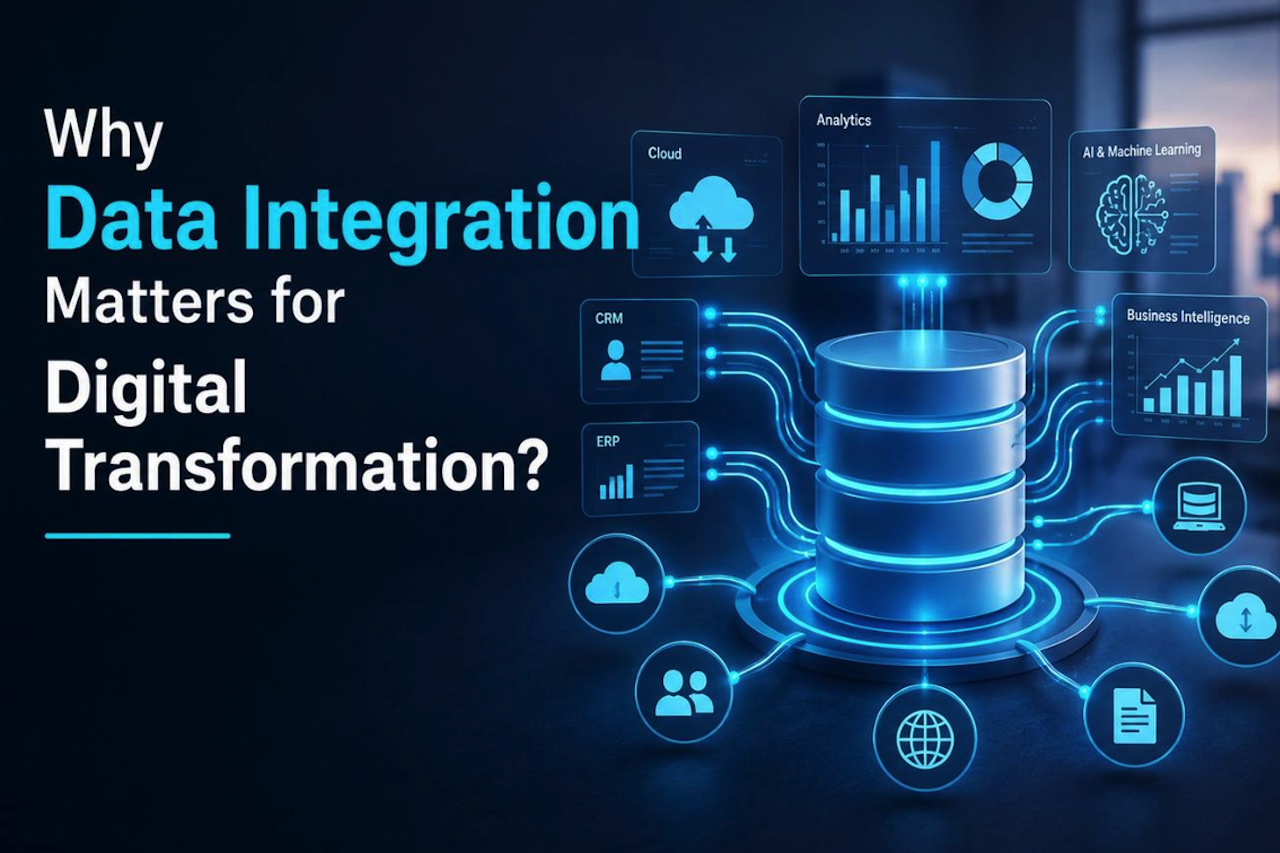
Today, any company in the world of business strategy gives a high priority to digital transformation. In doing so, it employs a number of technologies in order to function more efficiently and improve the quality of customer service. Nevertheless, companies can be successful in using all kinds of digital technologies only if they can provide smooth communication among their applications, business functions, and departments.
As analysts say, enterprises use 350 applications on average, with large firms utilizing more than 1,000 sources of information. Meanwhile, IDC predicts that the amount of data created globally in 2028 will exceed 390 zettabytes, showing that companies need to manage disparate data. Without efficient data integration, digital transformation projects often fail to achieve their goals because of inconsistent reports, duplicated information, and delayed decision-making.
Understanding Data Integration
Data integration entails combining data from distinct systems, applications, databases, and cloud computing in one coherent picture. Accessing reliable information through integrated data allows departments to capitalize on updated data rather than data sets.
Medium-sized firms run more than 150 random applications and systems, while large firms operate above 800 systems. Data integration prevents duplication of data, report irregularities, and manual data entry. It is reported that organizations lose 20% to 30% of employees’ productivity due to the time wasted in looking for the information stored in distant systems.
Integrated data forms a base for analytical activities in any organization.
The Relationship Between Data Integration and Digital Transformation
In order to achieve success in digital transformation, various technologies that include, but are not limited to, cloud computing, artificial intelligence, Internet of Things (IoT), and advanced analytics must be used. These technologies can only operate correctly when data is precise and accurate.
Digital transformation initiatives involve connecting customer relationship management solutions with enterprise resource planning software, financial systems, supply chain applications, and marketing tools. Data integration is what makes this communication possible.
For instance, in the case of connected machinery, manufacturers can obtain approximately 5 terabytes of operational data every day. This data, when integrated with maintenance, inventory, and quality systems, can help decrease downtime by almost 25% and increase production efficiency.
The lack of integrated data may cause delays in digital transformation initiatives, imprecise reporting, and decreased ROI.
Advantages of Data Integration
Data integration creates evident benefits to businesses in different areas of operations.
- Improves accuracy of reporting by eliminating duplication and inconsistency in records by 40%.
- Improves speed of decision-making thanks to real-time dashboards that allow for immediate updating of information.
- Improves customer experience due to the merging of data from sales, customer support, and marketing systems.
- Helps comply with regulations through standardized and traceable data management.
- Reduces manual work done when entering data, allowing employees to save thousands of hours every year.
These advantages create a strong digital base, enabling organizations to respond to changes in the market effectively.
Different Industries Impacted by Business
Different industries apply data integration to resolve different operational issues at the same time, contributing to their digital transformation projects.
| Industry | Digital Transformation Benefit |
|---|---|
| Healthcare | Integrates patient records, reducing administrative processing times by nearly 30% |
| Manufacturing | Connects production systems and predictive maintenance platforms to reduce downtime |
| Banking | Combines customer data from multiple channels to strengthen fraud detection |
| Retail | Synchronizes inventory, online sales, and customer purchasing behavior for improved forecasting |
| Logistics | Integrates transportation, warehouse, and tracking systems to improve delivery visibility |
This integration of information enables speedier analytics and better strategic decisions across these industries.
Typical Problems Organizations Encounter
Despite the great advantages of data integration, it is important to implement it well, which is possible only with proper organization beforehand. Organizations usually face difficulties with bad-quality data, legacy systems, as well as meeting security requirements.
A large number of companies still rely on systems that are over 15 years old. In addition, there are organizations working with data stored in multiple databases in different locations around the world.
Another problem is low-quality data. Studies show that faulty data costs organizations millions of dollars every year in terms of reporting mistakes, operational inefficiencies, and delays in decision-making. The introduction of uniform data governance decreases these risks and increases reliability in the long run.
Moving into the cloud provides new challenges for integration since companies have to manage hybrid environments where classic and virtual systems function.
Developing Trends Influencing Data Integration
The growing need for integrated business information results in constant investment in contemporary integration technologies. Data Intelo states that the size of the worldwide market of data integration was estimated at $18.48 billion in 2025 and will grow to $47.88 billion by 2034 while increasing at a CAGR of 11.2% for the given period. The rise in the market size comes from cloud computing technologies, AI-enabled analytics, and hybrid IT environments, which depend on the delivery of relevant data.
Modern data integration does not stay still and continues developing along with the emergence of new technologies like AI, automation, and cloud technologies. Intelligent integration platforms automate processes like data mapping, anomaly detection, and quality assurance.
Real-time integration is making its way into business processes in response to the growing amount of streaming data from connected devices, online transactions, and digital platforms. Some multinational corporations analyze millions of transactions every hour, making it necessary to synchronize information continuously rather than perform scheduled updates.
Due to their ability to cut down on the time spent in development, low-code integration technologies are becoming more sought-after. This minimizes the time it takes to launch business processes. At the same time, AI-powered tools automatically discover data inaccuracies, since they are much more efficient at searching for missing values and duplicates than traditional methods.
The potential of these innovations continues growing in the sphere of digital strategies.
Final Thoughts
Digital transformation involves more than just acquiring new technologies, as it comes with effective means of information flow management. Thanks to the implementation of data integration, it becomes possible to break the barriers between information silos and make proper decisions based on analyses performed.
As companies continue transforming their business processes by incorporating more and more cloud solutions, automation, and artificial intelligence into their operations, the role of integrated information will increase. Companies that integrate data into their operations will gain a competitive edge over their rivals.
Author

Ashish Kolte
0 Comments
Comments are moderated to keep the discussion useful and respectful. Spam, automated submissions, and low-value promotional comments are removed.
Leave a Comment