
| Raksha Sharma | Cloud Services, Networks, Cybersecurity
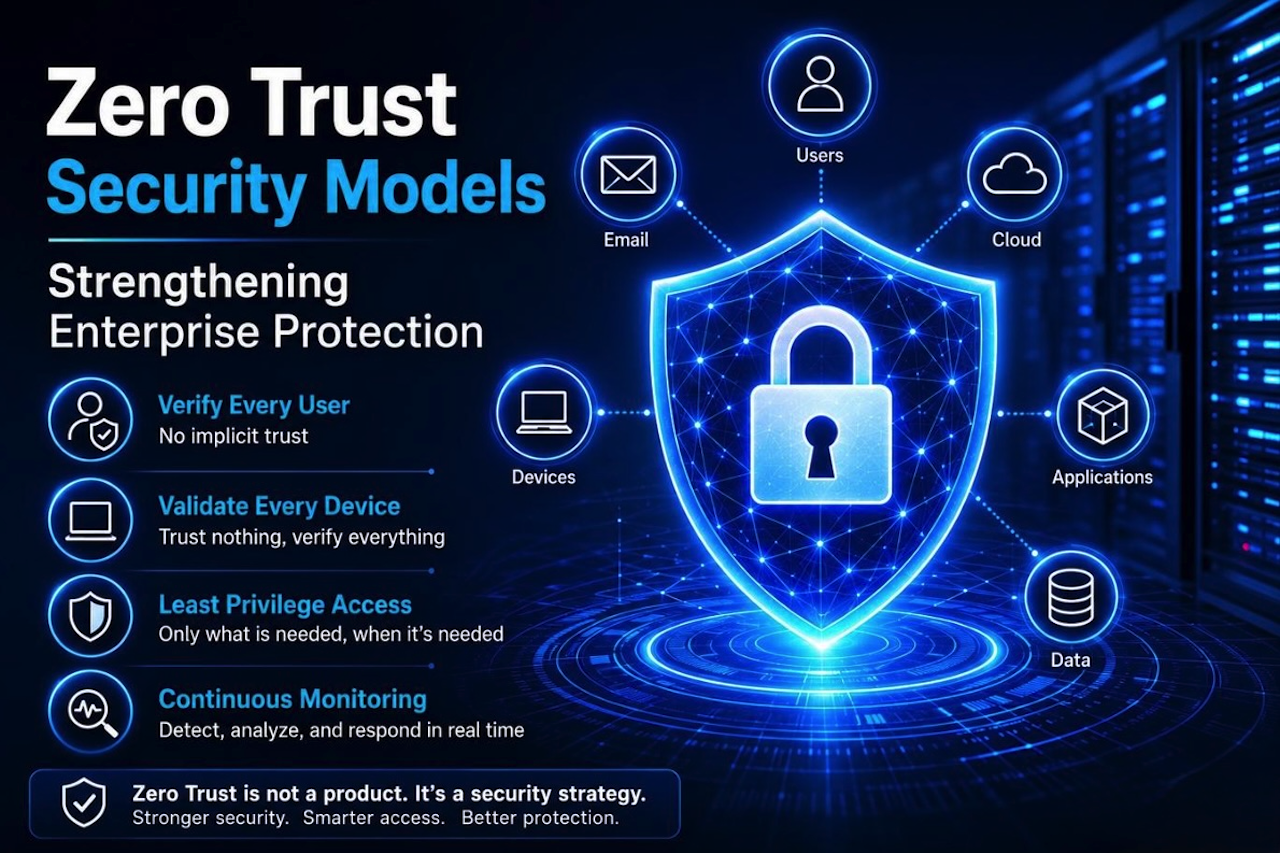
In the world of cybersecurity, protecting against the fixed perimeter of a network has changed to safeguard the user, devices, operating systems, applications, and data. With advancements in cloud computing, IoT devices, hybrid work, and malicious cybercrimes, conventional security methods no longer hold true. Companies across industries are embracing Zero Trust, a paradigm defined by the rule "never trust, always verify".
The evolution of Zero Trust is confirmed by future market forecasts. For example, Market Intelo predicts that the global zero trust security market will reach USD 62.4 billion in 2025 and USD 195.8 billion by 2034, with a growth rate of 17.3% in the concerned period.
Introduction to the Zero Trust Security Model
Zero Trust refers to a cybersecurity model based on the idea that no user, device, or application should be trusted automatically, whether this entity is inside or outside the business's office network. Before granting access to the asset, each request is subject to verification through various security means.
Zero Trust differs from traditional perimeter security in that it not only requires authentication but also considers other parameters, such as user identity, device health, location, network behavior, and more. Studies show that about 80% of enterprise workloads are processed in different cloud environments, which makes continuous verification much better than relying only on network boundaries.
With this kind of architecture, the company receives fewer access permissions and minimizes attackers’ attack options after they manage to breach the user credentials or get access to internal systems.
Why Traditional Security Models Are Insufficient
Most enterprise networks have been developed under the impression that users operating in the corporate infrastructure can be trusted. This idea has significantly diminished due to the introduction of remote operations and cloud services.
Cybercriminals are focusing more on the exploitation of compromised credentials than vulnerabilities of software. As industry reports suggest, more than 60% of all confirmed data thefts involved some form of stolen or misappropriated credentials.
There are several reasons to accelerate the implementation of the Zero Trust approach.
- The rise of remote work results in an increase in remote access points.
- Organizations are often dealing with tens of thousands of connected devices, from smartphones and laptops to servers and IoT devices.
- Cloud applications now store a significant share of sensitive enterprise information.
- Ransomware groups increasingly target identity systems before encrypting data.
These factors make the management of enterprise security even more complicated than it used to be.
Core Principles of Zero Trust
Successful Zero Trust implementations rely on several complementary security practices rather than a single technology.
| Principle | Purpose | Business Benefit |
|---|---|---|
| Identity verification | Authenticate every user continuously | Reduces unauthorized access |
| Least privilege access | Limit permissions to necessary resources | Minimizes attack surface |
| Multi-factor authentication | Require multiple verification methods | Prevents credential-based attacks |
| Continuous monitoring | Analyze user and device behaviour | Detects suspicious activity faster |
| Micro segmentation | Divide networks into isolated section | Limits lateral movement after compromise |
According to industry research, organizations that implement MFA as well as least privilege access control enjoy notably fewer instances of credential theft compared to the companies that rely solely on passwords.
Business Benefits Which Go Beyond Cybersecurity
Despite the fact that Zero Trust is mainly a security system, it can also be helpful as a tool for operating performance and legal compliance.
By deploying the Zero Trust policy, organizations obtain better access visibility since all access requests are logged and evaluated. Such monitoring helps comply with privacy legislation and industry requirements, which demand high standards of access control.
In addition, operational efficiency is increased through the use of centralized identity management. Using uniform access rules across systems eliminates inconsistent access controls.
From a financial point of view, more reliable prevention systems lead to fewer expensive security incidents. Today, the damages because of a data breach amount, on average, to over USD 4 million.
Obstacles Encountered Throughout Implementation
While Zero Trust has many advantages, it is also not a deployment that can take place in a day. Large companies often rely on legacy systems that do not allow continuous identity verification and granular access controls.
The typical migration will involve integrating identity providers, endpoint management, network segmentation technologies, and security monitoring systems. When dealing with tens of thousands of workers and devices, implementing the system might take years.
Training employees is also important. Employees might find extra verification steps inconvenient, which highlights the need for programs that help them see that tougher measures are needed to minimize risk for the company with minimal limitation on their work.
The Outlook for Enterprise Security
The approach of Zero Trust develops side by side with advancements in such technologies as AI, behavior analytics, and threat detection. Contemporary security platforms are increasingly focused on analyzing users’ behavior in real time, catching abnormal login habits, what’s referred to as impossible travel, and unusual device operation.
Experts predict that over 70% of new implementations in the field of enterprise security will include Zero Trust principles by the year 2028, which emphasizes the significance of Zero Trust in the sphere of cybersecurity.
Zero Trust does not consider it necessary to get rid of all the existing security technologies but rather seeks to incorporate identity management, endpoint security, encryption, monitoring, and access control into the coherent concept that perpetually ensures trustworthiness of any digital transaction.
Conclusion
The growth of cloud computing, remote working practices, and Internet-connected devices has transformed the way organizations secure their systems and data. Perimeter defense mechanisms are no longer enough to protect companies, as today’s threats usually take advantage of valid credentials and compromised identities.
Zero Trust solves these problems through constant authentication, minimal access rights, and tracking all connections between users, devices, applications, and networks. While implementing Zero Trust requires a sound strategy and commitment from the business entity, this concept enables companies to significantly improve their security.
Author

Raksha Sharma
0 Comments
Comments are moderated to keep the discussion useful and respectful. Spam, automated submissions, and low-value promotional comments are removed.
Leave a Comment