
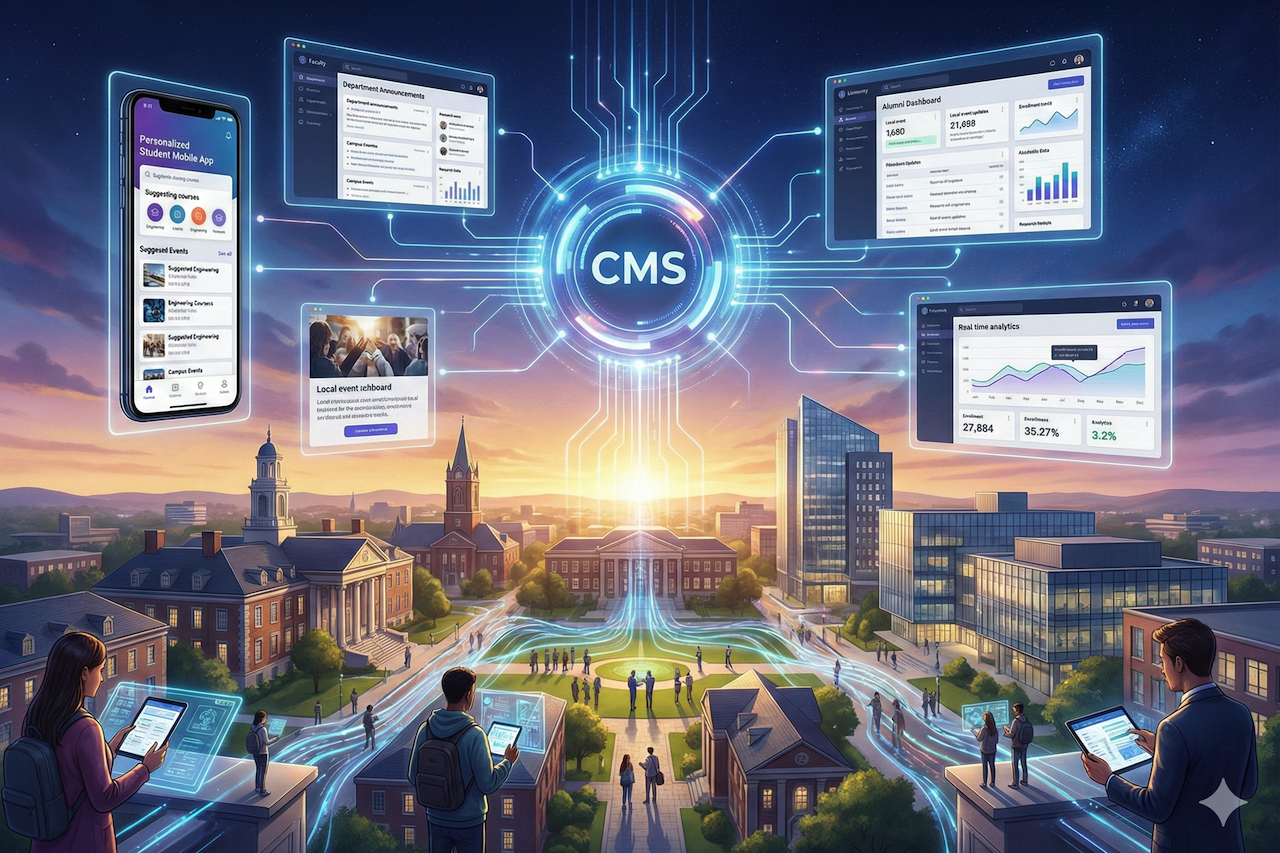
Education has changed dramatically over the last decade. Today’s students expect the same seamless digital experience from their university that they get from streaming platforms, online shopping, or banking apps. Static websites and outdated systems cannot keep up.
This is where modern Content Management System (CMS) platforms come in.
A content management system is no longer just a tool for updating webpages. It has become the digital backbone of educational institutions, powering student experiences, simplifying internal workflows, and enabling smarter decision-making. Let us explore how this transformation is happening.
Dynamic Digital Campuses to Static Websites
University websites used to be primarily informational. Courses, faculty information, and entrance dates were mentioned. Departments frequently operated in silos, updates were sluggish, and personalization was non-existent.
The capabilities of a CMS have been completely reimagined by contemporary platforms such as Sitecore, Contentstack, Adobe Experience Manager, Strapi, Umbraco, and WordPress.
A university website can now serve as a virtual campus. It is multi-system connected, responsive, and individualized.
Customized Experiences That Are Really Important
Consider this:
- When a potential engineering student hits your website, they see faculty highlights, relevant programs, and laboratories right away.
- Regionally specific content, such as visa advice, is displayed to overseas students.
- Updates on local events are sent to alums.
- Faculty members can view department-specific announcements after logging in.
This is made possible by behavioral tracking and personalization in contemporary CMS platforms. Institutions can design relevant digital journeys for each target segment rather than displaying the same content to everyone. This boosts retention, application rates, and engagement.
Giving Departments More Authority Without Losing Control
Thousands of pages and hundreds of departments are common characteristics of large universities. Organizing material for several teams can easily get hectic.
This is resolved by current CMS platforms with established governance aspects such as:
- Access controls based on roles
- Workflows for approval
- Tracking versions
- Centralized brand control
This means that while departments are free to update their own content, the marketing team maintains brand consistency. It establishes balance by combining flexibility and structure.
Assisting Learners at Every Digital Point of Contact
Students no longer exclusively use desktop websites to communicate with colleges. They communicate via email, social media, learning management systems, student portals, and mobile apps.
Platforms such as ContentStack use a headless CMS architecture that keeps design and content separate. This enables organizations to publish content once and easily communicate it across a variety of channels.
Everywhere students interact, the experience is consistent.
Smooth Campus System Integration
Contemporary CMS systems don't function independently. They interface with marketing automation platforms, learning management systems, CRM tools, and student information systems.
For instance, the admissions CRM may be instantly updated when an inquiry form is submitted. Based on how they browse, students can receive customized follow-up emails. Real-time synchronization of application progress updates is possible.
By removing data silos, these linkages build a networked digital ecosystem for universities.
Improved Compliance and Security
Sensitive data, including research materials, financial information, academic records, and personal information, is handled by educational institutions.
Enterprise-grade security features such as role-based access controls, encrypted cloud hosting, automated updates, and compliance with international legislation are built into modern CMS platforms.
Security is not a secondary concern. It is fundamental.
More Agility and Quicker Updates
The pace of education is rapid. New initiatives are introduced. Projects for research are created—admissions timelines change.
Institutions can efficiently expand admission campaigns, create event pages, update program data promptly, and launch landing pages in a matter of hours thanks to modular components and reusable content blocks.
Institutions benefit from digital agility in education, particularly in internationalization.
Making Better Decisions With Data
Access to robust analytics tools is made possible by contemporary CMS platforms. Institutions can learn which programs are most popular, where students lose interest in applying, which regions are growing, and how users interact with the website.
Instead of relying solely on guesswork, these insights help organizations continuously improve their plans.
The Big Picture: An Organization Focused on Digital
Fundamentally, a contemporary CMS is more than just a technological advancement. It represents digital transformation in education. It exhibits long-term flexibility, scalable digital expansion, operational efficiency, and student-centric communication.
Institutions that invest in cutting-edge CMS platforms put themselves in a better position to attract, retain, and engage students as the global and competitive nature of education grows.
Conclusion
These days, perception, trust, and enrollment decisions are greatly influenced by the digital experience in higher education. Learners anticipate smooth communication, pertinent content, and easy navigation.
These expectations can be met with the help of contemporary CMS platforms. Implementing a modern CMS for educational institutions is more than just building a website; it's about helping them thrive in a digital-first world.
The goal is to create a more intelligent and connected campus environment for all participants.
Featured Image generated by Google Gemini.
Share this post
Leave a comment
All comments are moderated. Spammy and bot submitted comments are deleted. Please submit the comments that are helpful to others, and we'll approve your comments. A comment that includes outbound link will only be approved if the content is relevant to the topic, and has some value to our readers.
Comments (0)
No comment